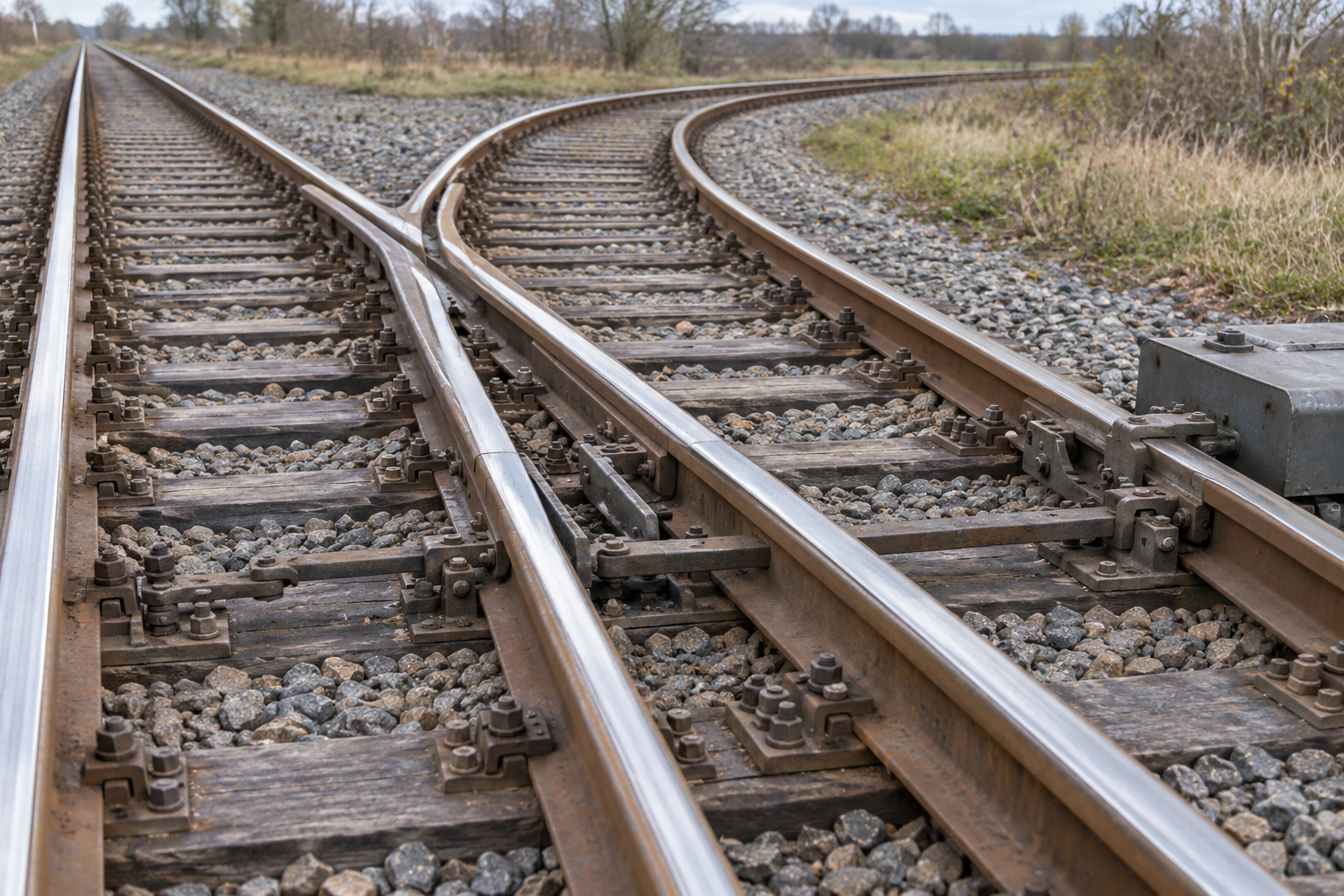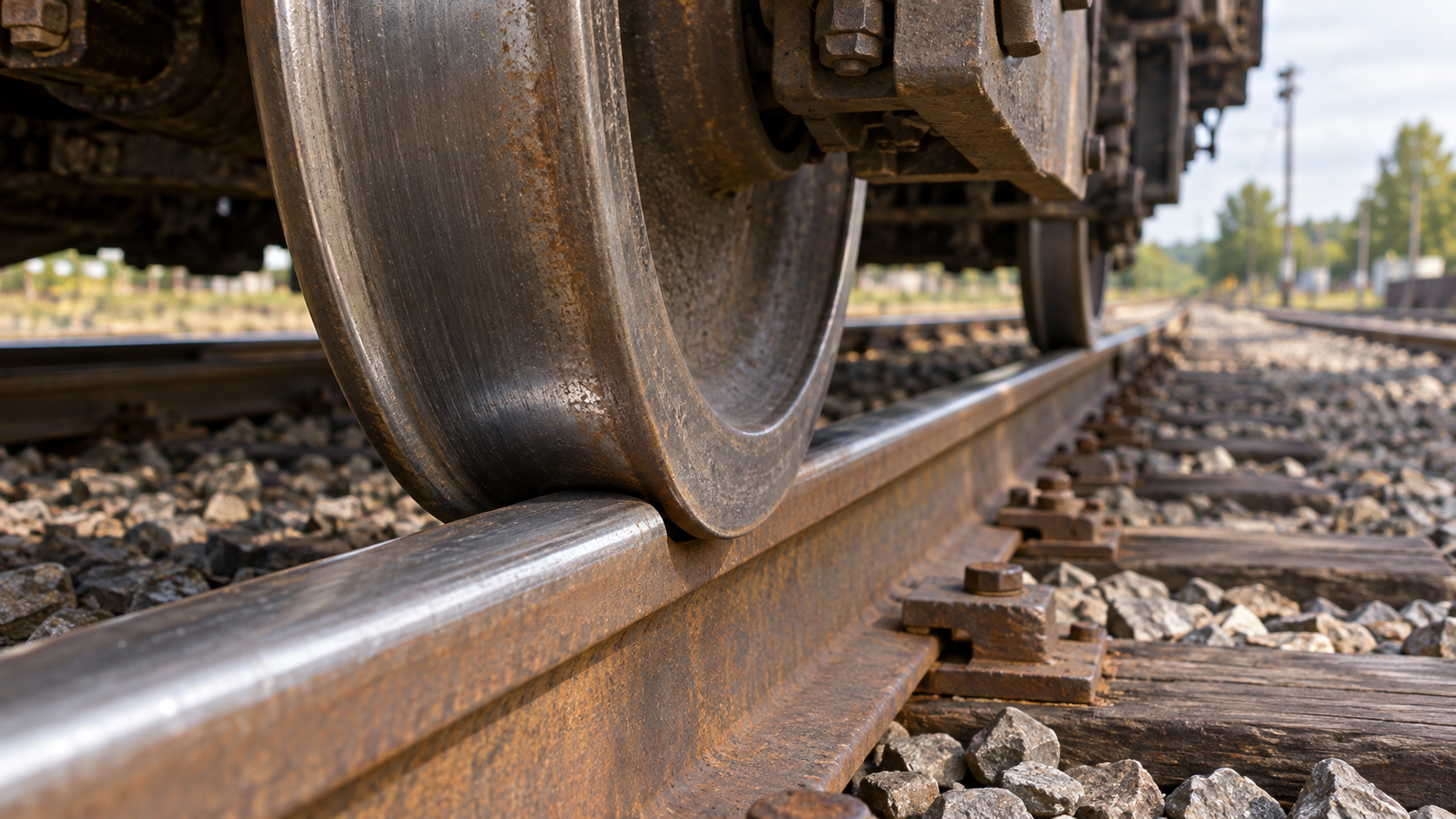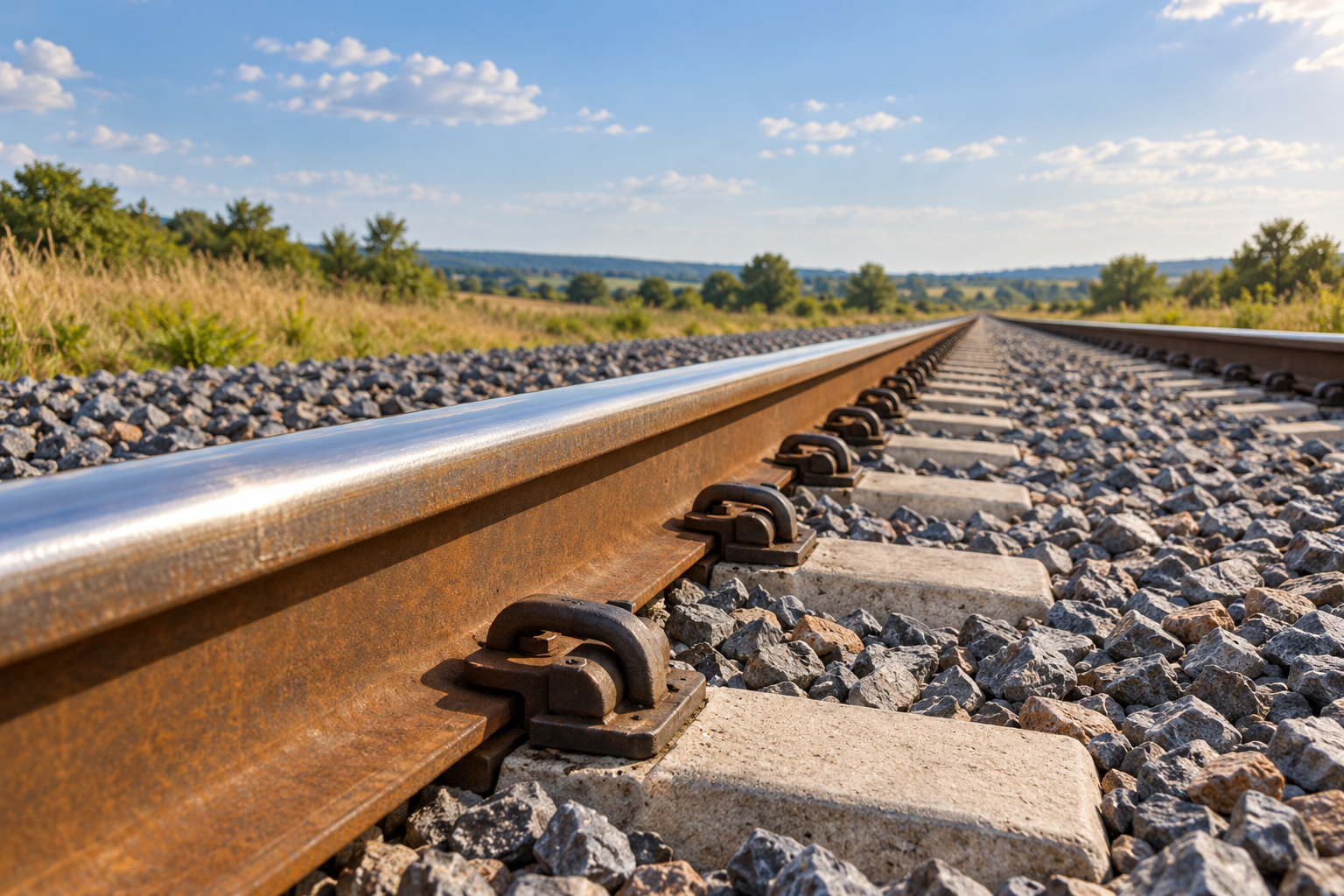
From a platform, a modern railway can look as though its two rails run without a break toward the horizon. Where does the steel go when a hot afternoon makes it want to grow longer? The familiar answer—leave a gap between rail ends—belongs mainly to jointed track. Much of today's mainline track is welded into long continuous lengths. Its room for summer is made in a less visible way.
The distinction is more than a change in appearance. Network Rail's 2021 adaptation report describes both jointed and continuously welded track on the British network. The former has connections between shorter pieces; the latter lacks the frequent joints that allow each piece to expand freely. Welding removes many joints and their associated maintenance, as the Met Office's account of railway weather explains. It also changes the engineering question from how wide a gap to leave to what force the restrained rail and its support can bear.
The temperature belongs to the steel
Air temperature is an imperfect guide to this problem. A rail in direct sun can be much hotter than the surrounding air. Network Rail says the difference can reach 20°C on its network. Shade, cloud, wind and the energy reaching the metal all affect the rail's surface temperature. The Met Office describes a rail-temperature model that calculates incoming and outgoing energy at the rail from local weather forecasts. The value that matters mechanically is the temperature of the rail itself.
A free length of steel would lengthen as it warms. A long welded rail is held along its route by fastenings, sleepers and the track beneath them. Restraining its length turns some of that urge to expand into longitudinal compression. Cooling below its chosen reference condition puts it in tension. The Federal Railroad Administration's research note on welded rail calls the temperature at which the rail carries neither longitudinal tension nor compression its neutral temperature. That is the number behind the phrase “stressed rail.”
During installation or repair, engineers can set the rail so that this neutral point suits the climate and the track. They may pull a rail to the length it would have at a warmer temperature before fastening and welding it. A Federal Railroad Administration report on buckling prevention describes mechanical tensors and heating used to obtain a desired neutral temperature when the actual rail is cooler. Network Rail says its British rails are stressed to a 27°C reference. That is a British operating choice in its public explanation, not a universal steel constant.
Choosing a warmer neutral point reduces the compression at a given hot rail temperature. It also means more tension at a given cold one. Network Rail's account of broken rails describes that winter side of the balance: cold rail under tension and repeated train loading make defects consequential. Summer and winter cannot be designed independently by simply moving the neutral point higher without cost.
The track holds the line
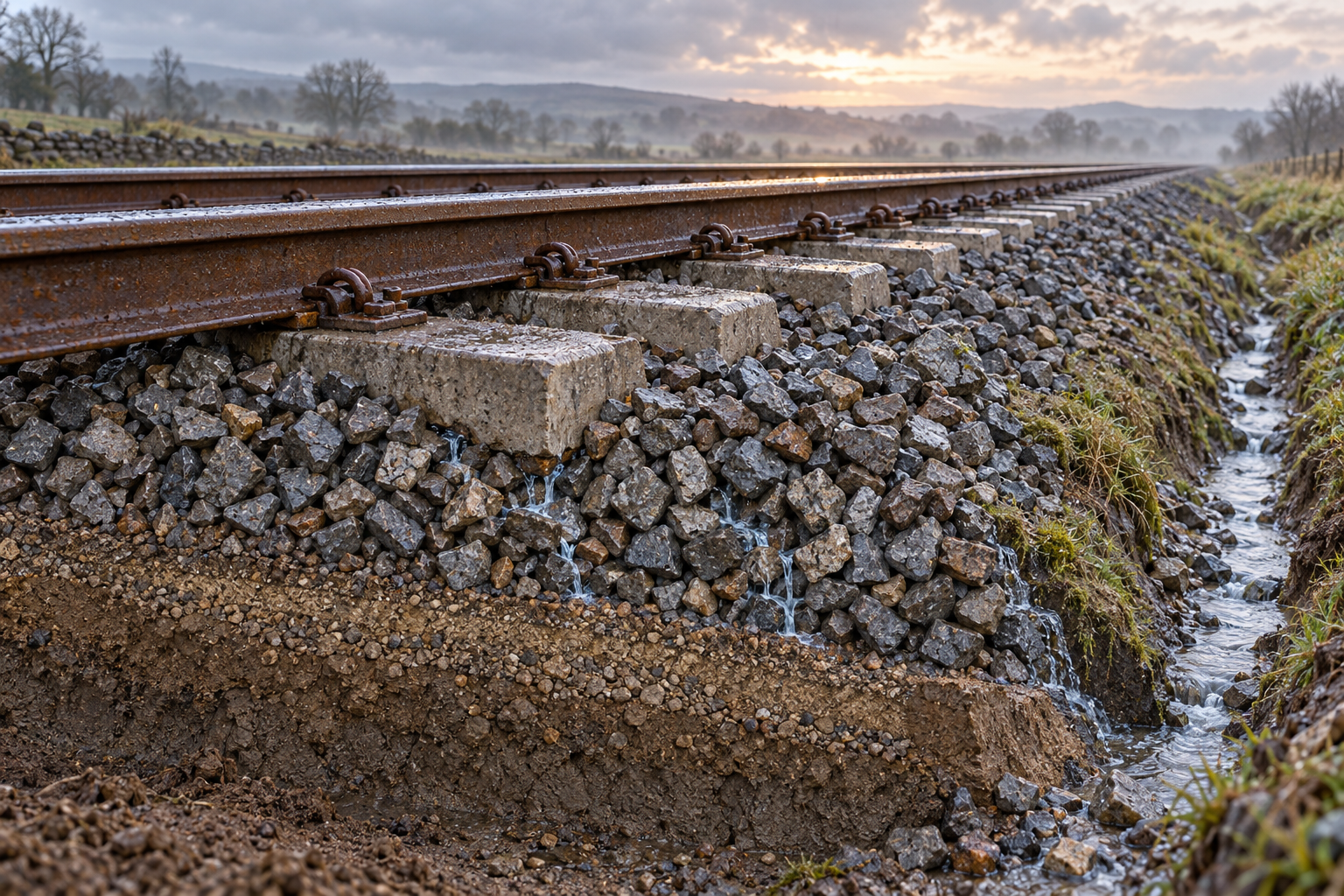
Compression does not automatically make a rail visibly buckle. The rail is part of a structure. Fastenings hold it to sleepers; the sleepers bear against ballast or another track foundation. The mass and resistance of that assembly oppose sideways movement. Network Rail's heat explanation puts sleepers and ballast at the center of the protection, alongside the chosen rail stress.
The surrounding track is never perfectly uniform. A small sideways misalignment offers compression a direction in which to push. A curve, a weak shoulder of ballast, recently disturbed track or a change in fastening resistance can alter the margin. The FRA's detailed buckling model examines curvature, lateral resistance, fastening behavior, initial misalignment, rail size and vehicle forces together. Its purpose is to evaluate combinations of conditions; it does not supply one air temperature at which every railway suddenly becomes unsafe.
The neutral temperature itself can change during a rail's working life. The same FRA report notes that rail creep, movement in curves, settlement and maintenance can shift it away from its installation value. Network Rail's adaptation report likewise identifies track support defects and work around the track bed as factors that can increase buckling risk. The record of how a rail was installed is useful, but the present condition of rail and track must still be watched.
This is why two nearby sections on the same hot day may need different responses. Their steel can be at different temperatures, their support can differ, and one may have a weaker geometric margin. A forecast alone does not reveal all three.
What a summer restriction does
When heat raises the risk, a temporary speed restriction reduces the forces a passing train adds to the track. It does not cool the rail or erase its compression. Network Rail makes that distinction in its 2023 explanation of heat and buckling. If the track has actually buckled, trains cannot simply continue slowly over it; the line must be repaired before service resumes.
Knowing the rail temperature more locally helps an operator use restrictions where they are needed. In a 2025 report on its temperature sensors, Network Rail says sensors fitted to selected rails take readings every 15 minutes and transmit them remotely. That is a report of its monitoring practice, not proof that sensors remove the underlying risk. The same account explains why hand readings and broad precautionary restrictions can be disruptive: collecting the information itself takes access to the track.
Some measures act directly on the heat entering the rail. Network Rail also reports painting selected rails white to reflect more sunlight. The paint changes the rail's temperature rather than its chosen neutral point or the ballast's resistance. These methods work on different parts of the problem, so their effects should not be collapsed into a single promise that hot track can always stay open.
The welded rail along the platform has few obvious places to give. Its allowance for a summer afternoon lives in the stress chosen when it was set, in the steel's tolerance of force, and in the sleepers and ballast that keep it aligned. A thermometer on the rail, an inspection of the track beneath it and an occasional slower train are all ways of tending that allowance after the weld has disappeared from sight.
A thought worth keeping?