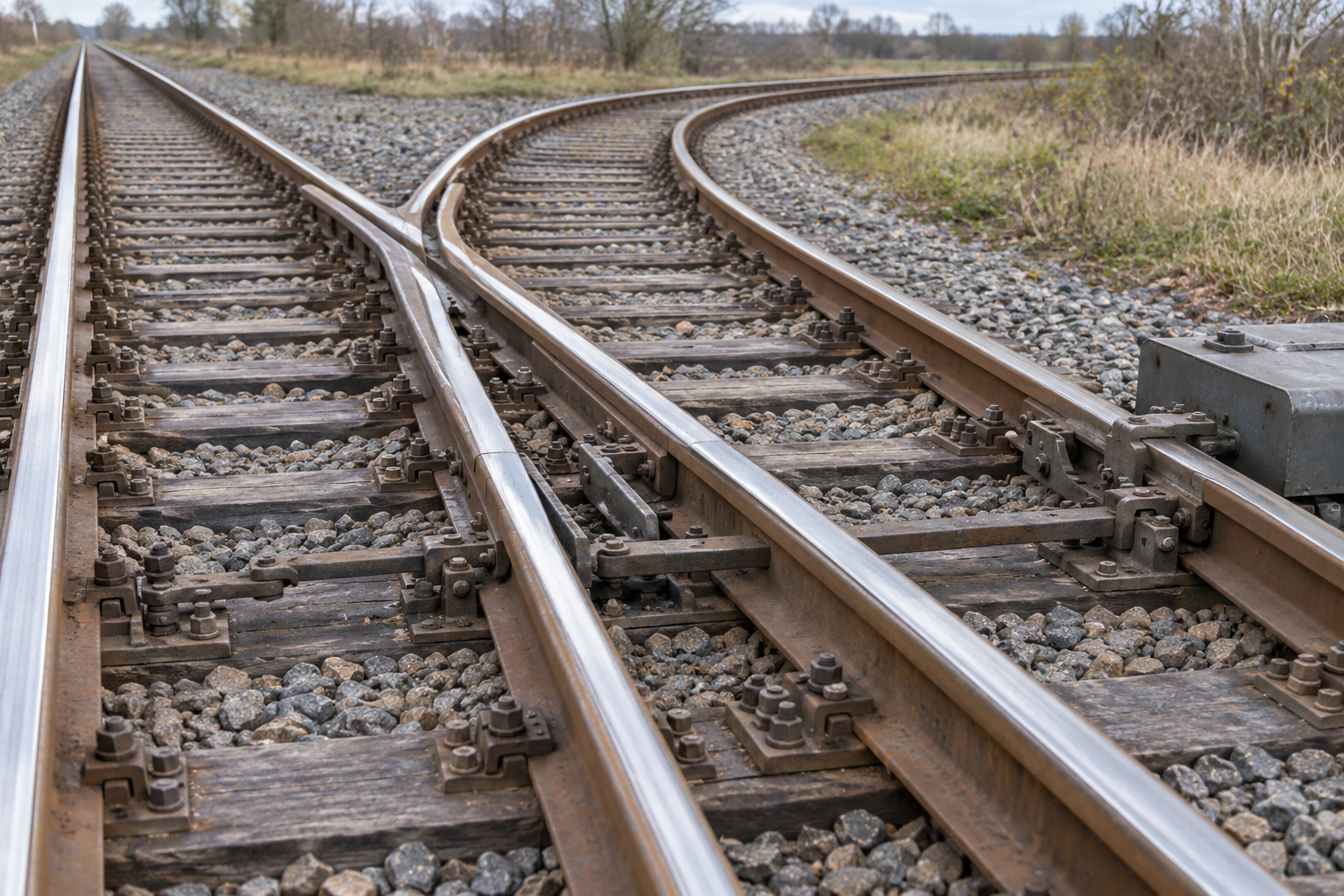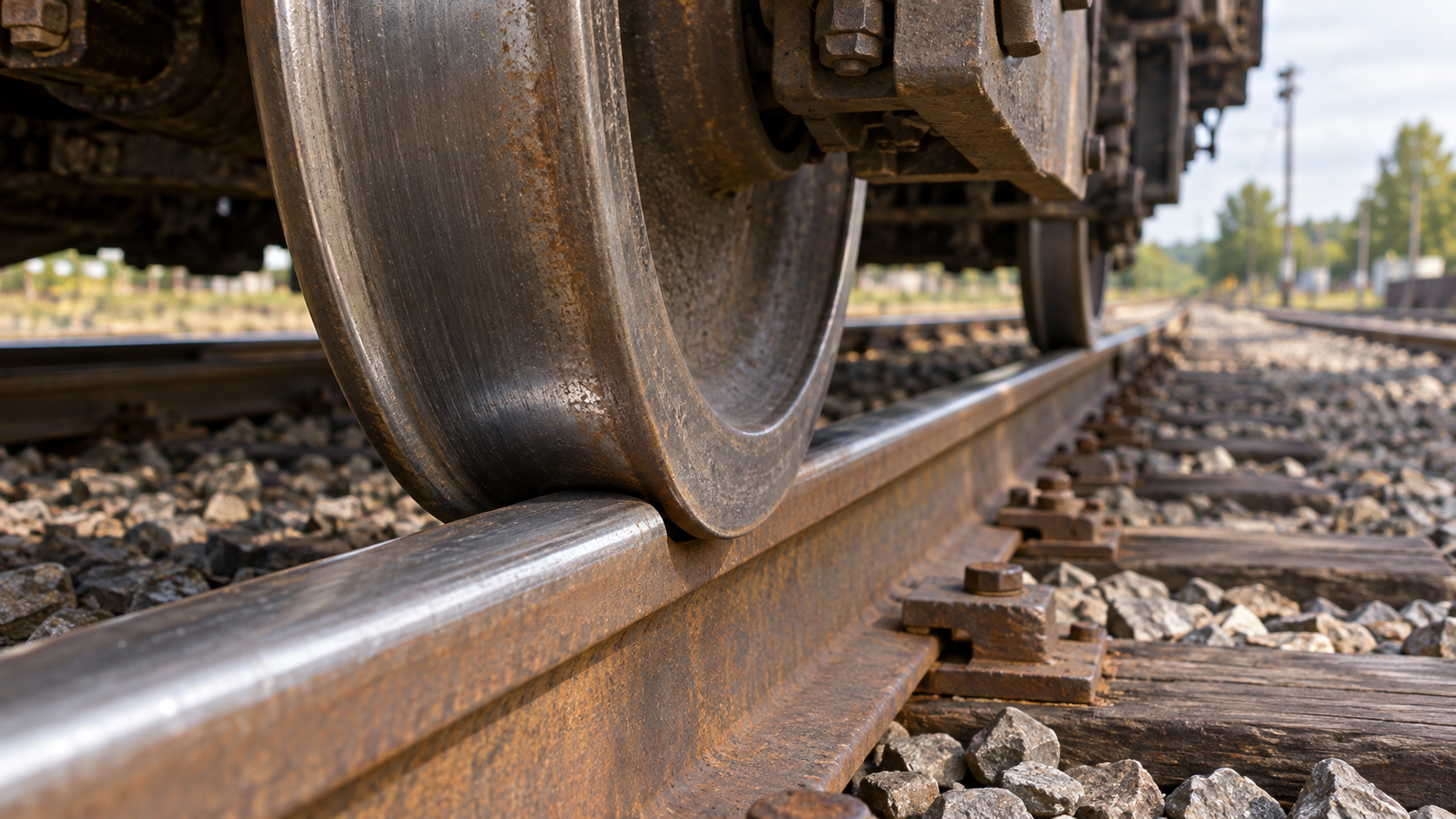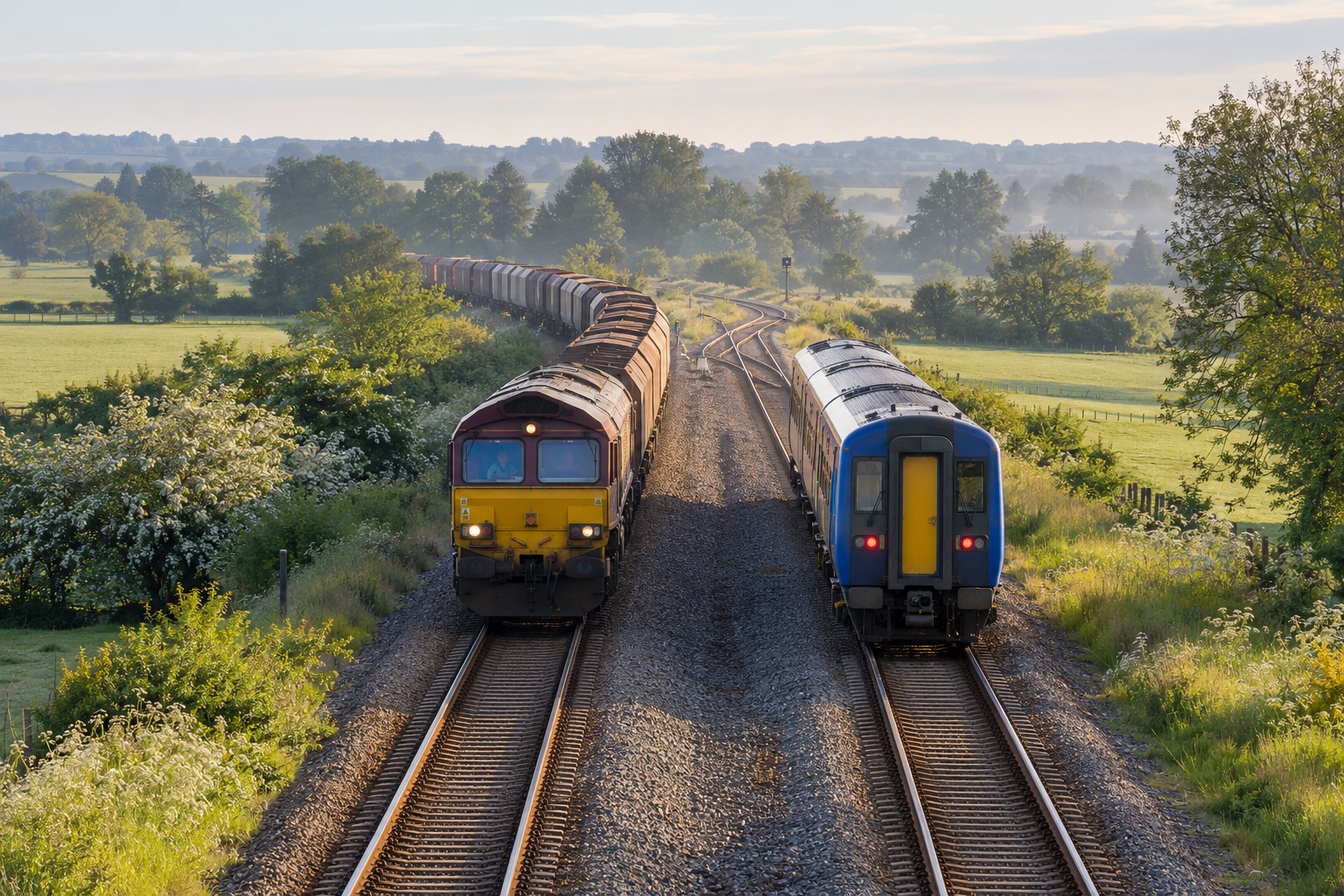
From the platform, the stones beside a railway look like the simplest part of the track. Under a sleeper, they have several jobs at once. They must take repeated loads without letting the rails sink unevenly. They must hold the sleeper against sideways movement. They must leave a route for rainwater, even as traffic presses the stones more closely together. The apparent heap is a working structure, and its open spaces matter almost as much as the rock.
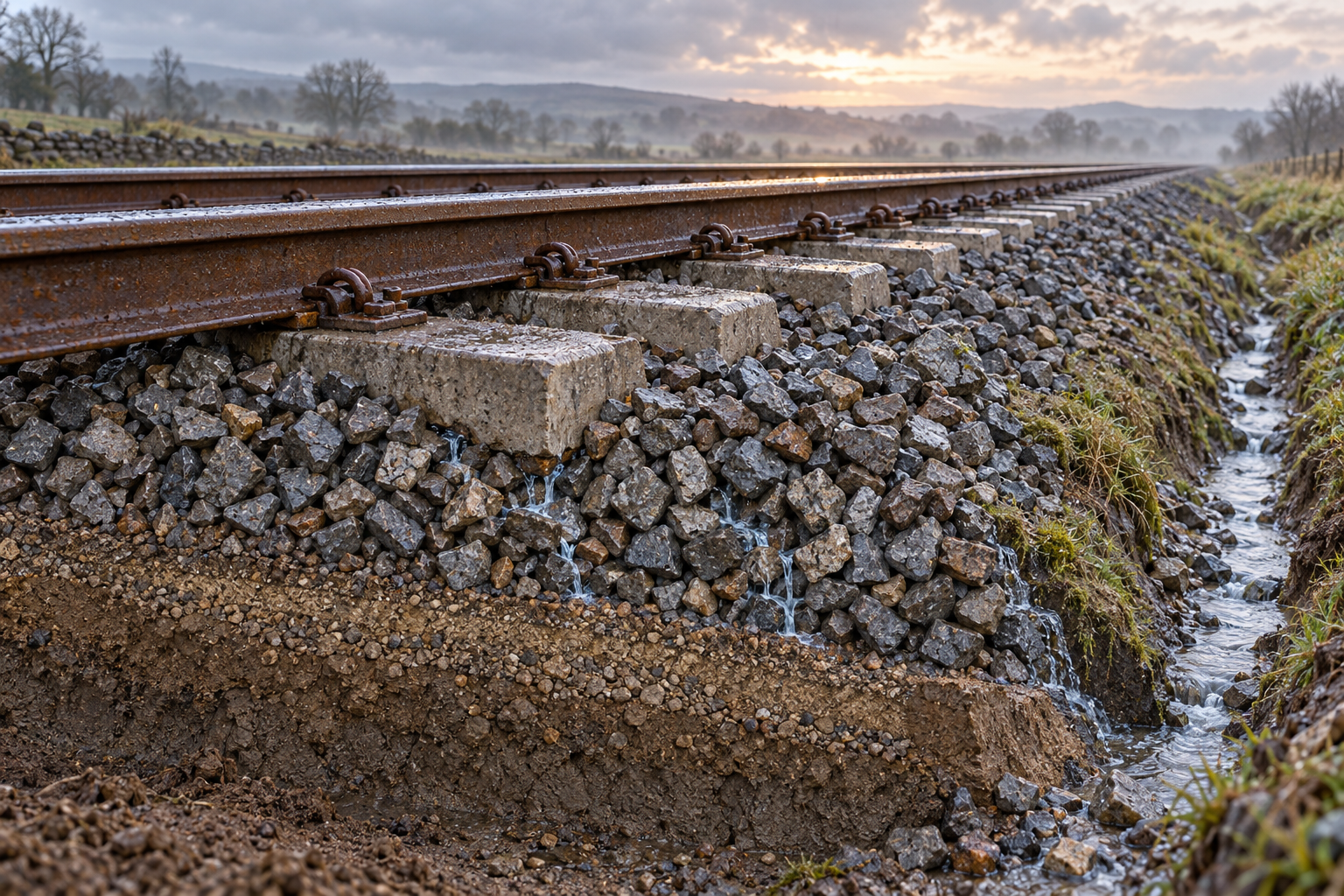
A wheel loads the rail; the rail and its fastenings pass that load to sleepers; the sleepers bear on the ballast. The stone layer spreads force toward the ground below, called the formation or subgrade. It also lets the track be adjusted: ballast can be moved under a sleeper to restore its level. The Federal Railroad Administration's 2023 research report explains that ballast depth helps distribute load to the subgrade, while the stone between sleepers and at their ends helps resist lateral movement. The necessary depth and profile depend on the track and the ground supporting it; there is no one layer that makes every weak foundation strong.
A foundation made of separate stones
Ballast works through many contacts rather than through one solid slab. Crushed, angular faces catch and press against their neighbours. The resulting interlock resists movement beneath and beside a sleeper. In Sysyn and colleagues' laboratory experiment, the shape and interlocking of crushed ballast mattered to the stresses measured under a scaled sleeper. Chen and colleagues' 2025 tests and particle simulations found that degradation changed particle shape and reduced the interlocking capacity of their tested assemblies. These studies illuminate the mechanism; neither supplies a universal strength value for an entire railway.
The shoulder of stone beyond each sleeper end is easy to overlook because it is not directly under a wheel. It nevertheless contributes to keeping the track aligned. When a rail warms and tends to expand, its fastenings and sleepers help contain the resulting forces. Ballast around the sleeper base, along its sides and at its ends provides part of the resistance to sideways movement. An FRA and Amtrak field test identified those contributions and examined what happened after track surfacing. A Network Rail engineering review likewise treats the volume and consolidation of ballast in the cribs and shoulders as factors in track stability during heat. The ballast cannot, by itself, remove rail stress or guarantee that a line will not buckle; it is one part of the restraint system.
The same stone bed has to remain permeable. Fresh ballast contains connected voids between its large pieces. Water can move through those spaces toward a suitable exit instead of lingering at sleeper level. This does not mean that ballast makes drainage automatic. A blocked ditch, poor outlet, low spot or weak wet formation can leave water in or beneath the layer. The Network Rail review considers ballast condition, the ability to shed water and drainage of the formation together, because the surface track and its foundation do not fail independently.
When the spaces fill
Traffic does not leave each stone untouched. Edges chip, grains abrade, and finer material collects in the gaps. Fines can also wash in from above or rise from a troubled subgrade. Engineers call this contamination fouling. It narrows the routes that water once took and changes how the granular bed carries load. The trouble is not simply that ballast becomes older or darker; what fills the voids, where it accumulates and whether it is wet all matter. The FRA's 2023 report distinguishes particle breakage, external fines, formation stiffness and tie support in assessing deterioration.
The contrast becomes visible in a controlled test. At the FRA's “Rainy Section”, a clean ballast comparison shed excess water within minutes. Dry, fine-filled ballast in the test took roughly a day; after wet mud pumping, excess water took roughly five days to drain. The settlement and stiffness also changed. Those times describe that test section, with its particular fines and drainage arrangement, not a stopwatch for any stretch of track. An earlier FRA drainage report makes the same limit explicit: drainage time depends on the kind and quantity of fines and on the available route out.
When water and fines meet repeated sleeper movement, they can form a slurry and be pushed toward the surface. The visible mud patch is a symptom of a deeper support problem, but its origin is not always the same. In the FRA's controlled section, investigators traced a wet zone immediately below the sleeper; elsewhere, a yielding subgrade may pump material upward. The 2022 experiment names fine-filled ballast, a water source and sleeper pumping as the ingredients in its observed mud-pumping mechanism. The 2023 FRA report warns that a soft subgrade can move the ballast above it and create standing water below. Pouring fresh stone on top cannot cure every failure beneath it.
Repairing support without losing restraint
Track crews can correct an uneven line by lifting it and packing stone under the sleepers. A tamper makes room with vibrating tines and squeezes ballast into the space beneath a raised sleeper, as described in a US transportation research report. This addresses geometry: the train needs a smooth, supported path rather than alternating firm and hollow seats. Yet newly disturbed ballast is not immediately the same interlocked bed it was before the machine passed. In the FRA and Amtrak field test, surfacing reduced the measured lateral resistance of the tested concrete-sleeper track; mechanical stabilization and subsequent traffic restored some of it. The percentages belong to that test, but the maintenance trade-off is general enough to plan for: lifting and repacking the stone can improve level while temporarily changing restraint.
Sometimes the correction needs to reach farther down. The 2023 FRA report links persistent settlement with tie support and subgrade condition as well as ballast quality. A 2014 British accident investigation found that recurring dips near Gloucester had formed with water flowing beneath the track; repairs to the visible geometry had proved ineffective. That case does not describe every wet line. It shows why cleaning contaminated stone, renewing it, improving drainage or repairing the formation are different answers to different faults. Inspection must ask where the weakness lies, because a rail that has returned to the right height can still sit on a bed that will move again under rain and load.
The stone beneath a sleeper is allowed to move a little; that is part of how a granular foundation can be worked back into shape. It must not move so freely that the track loses its line, nor pack so tightly with fines that water has nowhere to go. The rail above supplies the straight edge a passenger sees. Beneath it, innumerable contacts between stones, sleepers and earth keep making that straightness possible, one load and one rainstorm at a time.
A thought worth keeping?