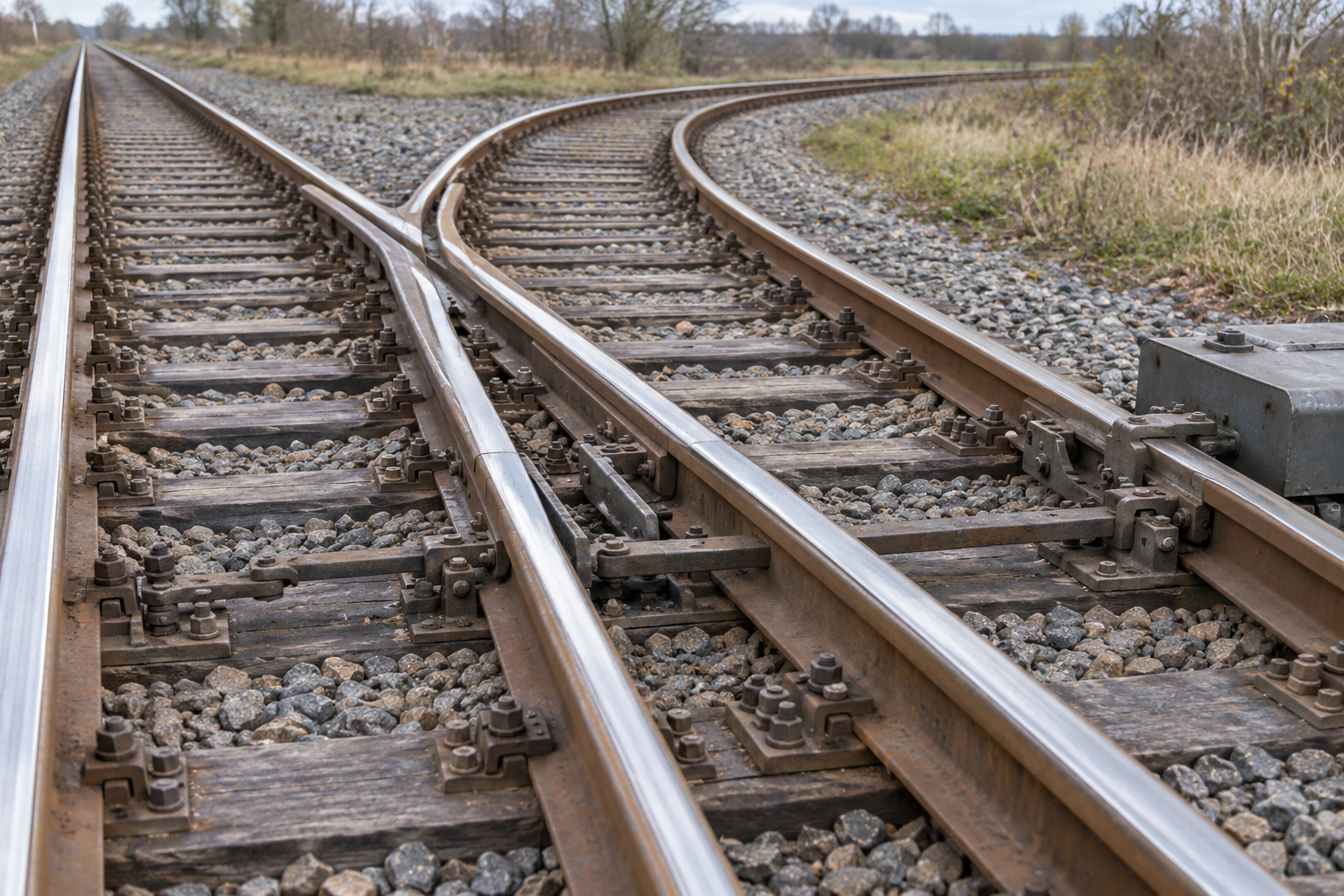
A railway switch looks like a decision made in steel. One route continues, another parts from it, and a narrow rail blade moves to choose between them. That visible movement is only the first question a maintainer has to answer. Did the blade reach the fixed rail closely enough to guide a wheel? Did the rods and drive move both blades together? Did the signalling system correctly learn where the rails ended up? A switch remains useful only while the physical route and the reported route agree.
British railway documents often call the assembly points, or switches and crossings. In the Rail Accident Investigation Branch's explanation of points, the movable switch rails lie against fixed stock rails, while stretcher bars hold the movable rails at a set separation and move them together. The thin end of a switch rail is called its toe. It is a small piece of steel to ask a large question of: which side of this rail will the next wheel take? The answer depends on the condition of many less visible parts around it.
The fit that guides a wheel
The first maintenance concern is contact. A closed switch point needs to fit its stock rail; an open one needs to leave the intended wheel path clear. A loose fastening, shifting support or worn rail can change the relationship even if the drive still moves. In a 2024 audit of the Port Terminal Railroad Association in Houston, the US Federal Railroad Administration inspected 284 switches and recorded 54 switch defects. Twenty-nine of those defects involved improper fit between point and stock rail. That is a finding about one audited railroad, not a rate for railway switches in general. It shows why an inspector has to look at the rail faces themselves rather than infer good fit from the fact that a machine moved.
One detail in the audit stays with me: inspectors found that heavy grease masked many of the poorly fitting points. Grease has a legitimate maintenance role at sliding interfaces. It can also make a narrow gap harder to see if it is applied without the accompanying checks. The audit recommended operating switches during monthly inspections to verify fit in both positions. Its point is practical. The route that looks sound while set one way also has to be examined when set the other way, under the requirements that apply to that railroad.
The 2007 derailment at Grayrigg in England shows how far a fit problem can extend beneath the obvious blade. The RAIB's Grayrigg report found a combination of failed stretcher-bar assemblies and fastenings, incorrect setup, and a missed track inspection. Those factors let one switch rail move toward an unsafe position without the signalling detection changing. The report treats the factors together; it would be inaccurate to explain that accident as a single loose nut or a single missed visit. The maintenance lesson is that the moving rail, its connections and its measured clearances form one mechanical system.
The movement must stay easy enough
A point machine or hand mechanism must shift rails through their full travel. Sliding steel meets baseplates, weather deposits moisture and grit, and repeated wheel loads change surfaces over time. At Knaresborough in 2015, points stopped in an intermediate position. The protecting signal remained at danger; the signaller then authorised a train to pass it without recognising that the points were unsafe, and the train derailed. The RAIB's investigation judged high friction at the baseplate-to-switch-rail interfaces the most likely explanation for the points' failure. Investigators found debris, rust, uneven contact and incorrect lubricant, and identified a combination of poor installed geometry and failure to follow the site's lubrication method. They also found that earlier similar failures had prompted repeated lubrication without a review of whether that scheme was working. The exact cause was not reproduced in a later functional test, so the report's “most likely” matters.
Cleaning and lubrication therefore need a purpose. The maintainer is trying to preserve the designed movement and contact, not merely to leave a shiny surface. A quick return to service after a repeat failure may remove the immediate delay while leaving the reason for the extra resistance unresolved. The Houston audit's grease-hidden gaps and the Knaresborough friction investigation point in different directions, but they meet at the same discipline: examine what the rail actually does after the work, in both commanded positions, and treat repeated trouble as information about the assembly.
Weather adds a different obstruction. Snow or ice can stop blades from completing their travel. Network Rail described in 2024 how its winter air surveys use thermal cameras to check whether points heaters are working. The heater is there to keep ice from jamming the metal blades; the survey checks the heater, rather than assuming that a fitted unit is a functioning one. That is one example from Britain's network, not a claim that every switch has a heater or that an aerial image replaces an on-site examination of rail fit.
The indication must tell the truth
Movement and detection are separate jobs. In a correctly functioning signalled installation, a failure to reach the required position should keep the protecting signal from clearing. That protection depends on the detector and its wiring testing the condition the railway needs to know. At Dalwhinnie in 2021, a double-ended crossover did not move into a consistent position, yet the signal could be cleared. The RAIB's Dalwhinnie report traced the false indication to two conductors left in a replacement point machine. They belonged in a single-ended installation but not in that crossover's detection circuit. A specified out-of-correspondence test, which would have exposed the discrepancy before the points returned to use, was not completed after the testing work was interrupted. An empty train subsequently derailed; no one was injured.
The two British accidents illuminate different ways for the same promise to break. At Grayrigg, the physical rail could move to an unsafe position without detection being lost. At Dalwhinnie, the circuit could report a safe position even while the two ends of a crossover disagreed. Neither case means ordinary point failures are routinely hidden; a correctly detected failure generally stops the route being signalled. They show why a maintenance visit includes tests of what the system reports, especially after equipment has been replaced. A green aspect is a consequence of several conditions being proved. It is not a direct view of the rail.
The work has distinct engineering strands. Network Rail's published safety management system identifies separate standards for switch-and-crossing design, track inspection and maintenance, and inspection and repair to reduce derailment risk. The Dalwhinnie investigation addresses signalling maintenance and test assurance at the same physical location. Keeping these responsibilities connected is part of looking after the whole switch. A mechanically adjusted blade and an electrically correct indication have to describe the same route before traffic resumes.
A scheduled inspection must become an actual one
Every inspection depends on access to a railway that is also trying to run trains. The Grayrigg investigation found that limited access contributed to a decision to combine two inspections; the switch concerned was then omitted from the visit, and the depot record was updated as if the work had been done. The report identifies that missed inspection as one of the accident's causal factors. Its lesson reaches beyond the track gauge or bolt: a plan and a completed record must correspond to an examination on the ground.
This remains an operational pressure, not merely a historical one. In its 2024–25 safety report, Britain's Office of Rail and Road said Network Rail was meeting switches-and-crossings inspection standards while also noting backlogs and temporary workarounds in parts of its maintenance programme. Those statements should be kept together. The regulator did not say the switch inspections were generally being missed; it warned that constrained access and resources can strain the wider system that makes planned maintenance dependable.
The small steel blade at the fork is still the most legible part of a switch. Behind its few inches of travel lie the surfaces it slides on, the bars that keep the pair together, the supports that hold their geometry, the detector that reports their position and the scheduled time to examine all of them. Maintenance is the repeated work of making those parts agree. When they do, the train passes the fork as though no decision had to be made at all.
A thought worth keeping?