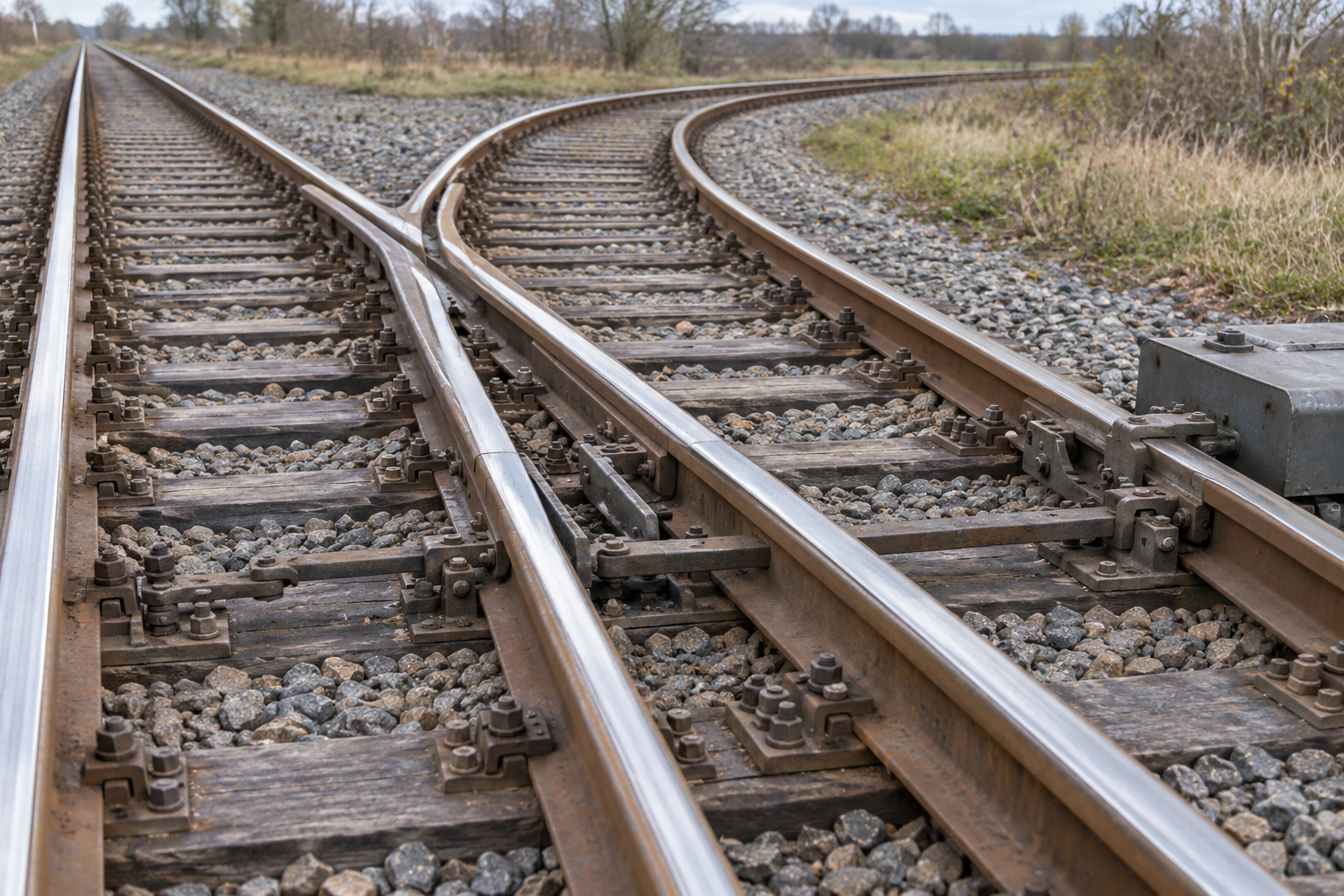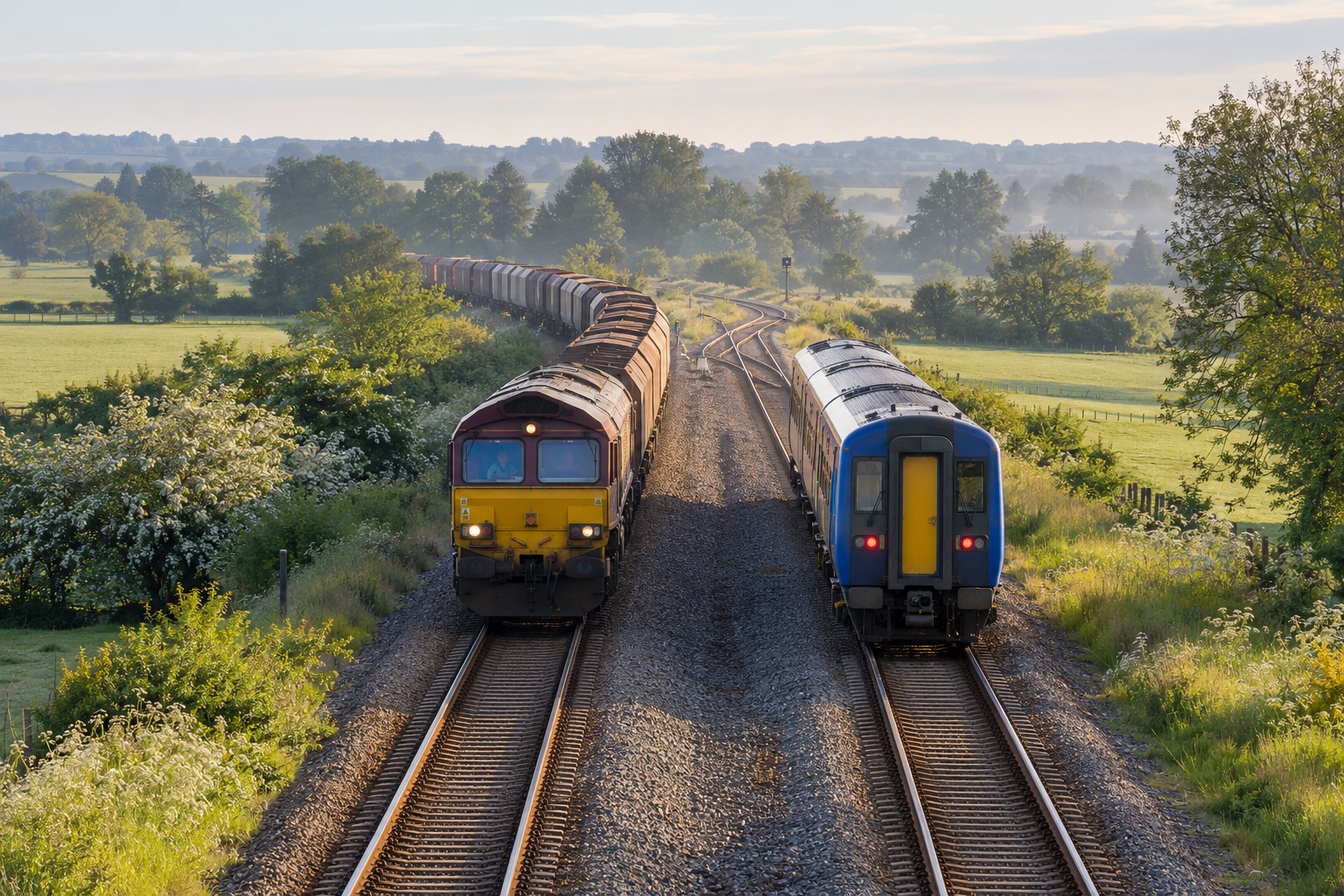
On a single-track railway, two trains approaching each other cannot simply pass at the point where their journeys happen to intersect. They need a place where the line briefly becomes two tracks. A passing loop supplies that place: one train takes the side track while the other uses the main, and each can then continue in the direction it came to travel.
The loop looks like a small addition to the landscape. In a timetable, it is a fixed appointment. If two opposing trains are planned to meet there, their departure times, running times, and stops on either side must bring them to the same short piece of railway in a workable order. Move one train's departure and the meeting may move beyond the loop, onto track where there is no room for it to happen.
The section that must be empty
Imagine a line with a station to the west, a passing loop in the middle, and another station to the east. An eastbound train reaches the loop first and enters its side track. A westbound train can approach from the east and pass on the main. Only after the routes are clear can both trains proceed into the single-track sections beyond the loop. The loop gives them two tracks for the encounter, but not two tracks for the rest of the journey.
This is more than etiquette between drivers. In the Australian Rail Track Corporation's rules for one centralised traffic control system, signals are interlocked to prevent opposing trains from receiving simultaneous proceed indications into the same single-line section between crossing loops. The rule is for that specified system, but it makes the operating constraint visible: a timetable cannot ask a signal to authorize two conflicting movements just because both trains are due.
For a regular service, planners must therefore fit train paths through available meeting places. A time–distance graph makes the problem plain. Each train's path is a sloping line; an eastbound and a westbound line may cross only at a station or loop where both can be accommodated. The crossing point has to account for the time to enter, clear a turnout, occupy the loop, and release the route. A 2025 study of cyclic single-track timetables models arrival and departure times, headways, station track assignments, and meet decisions together. Its mathematics is elaborate because the dependencies are real: a path that looks possible in isolation can conflict with another train, or with the next repeat of the same daily pattern.
The public timetable may show only a departure and an arrival. The working timetable has to resolve the meeting in between. Network Rail's explanation of its planning process describes how proposed services from passenger and freight operators are combined and checked for conflicts. A slow stopping train, a faster non-stop service, and a freight train cannot all be treated as identical lines on the graph. Their different speeds and stops alter where a planned meet can fall.
The minutes spent at the loop
Even a successful meet consumes time. A 2020 RailTEC study of single-track meets separates the stopping train's loss into braking into the siding, waiting for the other train to pass, and accelerating back to line speed. The wait includes more than the moment when the trains are side by side: switches and signals must be set and released, and the passing train must clear the relevant point. A late opposing train can lengthen the middle phase while the stopped train sits ready to go.
Some loops and signalling arrangements permit a running meet, with both trains moving. The RailTEC researchers note that this requires the trains to arrive close enough together and the loop to be long enough to preserve safe separation at their speeds. A loop that supports an easy stopped meet is not automatically long enough for two trains to sweep through at line speed. Its usable length, the turnout speed, and the signalling system matter as much as the diagram on a map.
Length can decide whether a meet is possible at all. A 2024 National Academies report on long freight trains explains that at least one train in a conventional meet must fit within the clearance distance between the sidings' end turnouts. A train longer than the usable siding may have to stay on the main; if neither train can fit, the dispatcher needs a different meeting point or a more complex movement. Thus a loop can exist on a route yet be unavailable to a particular pair of trains. Adding longer freight to a timetable changes the set of usable appointments, not merely the time it takes to pass a platform.
When the appointment is missed
A planned meet contains a quiet assumption: each train will reach its side of the loop within the margin allowed. If the eastbound train is late, the westbound may be held before entering the section. If the westbound is late, the eastbound may wait in the loop. Either way, the first delay now belongs partly to another train. If that second train has a later meeting, the disturbance can travel farther along the line.
This is an observed pattern, though no single multiplier describes every railway. Researchers at SINTEF and the Norwegian University of Science and Technology traced knock-on delays through five months of punctuality data on a Norwegian single-track line. In that case, more than 70% of the detected propagation events involved two trains, and the typical propagation factor was around two. The finding does not mean every late train doubles its delay. It shows how often a late arrival at one conflict can charge time to its counterpart.
Planners can give a meet room to absorb variation, but that room has to be put somewhere. Davis Dure's 1999 study of a proposed single-track light-rail route used simulation to place and lengthen sidings so that small delays would be less likely to cascade. The work concerned a proposed light-rail service, not every heavy-rail line; its broader lesson is that a loop's position and length make sense only in relation to the operating pattern it is meant to support.
Not every railway fixes the appointment months ahead. A 2016 RailTEC study contrasts structured timetables with more flexible North American operations, in which departures and running times can vary and dispatchers choose among possible meets. Flexibility gives the dispatcher choices, but the choices still lie at real loops of usable length. Moving a meet to the next loop may rescue one train's path while making another wait longer. The study's simulations found that even modest schedule flexibility could increase delay on a fixed infrastructure layout; that result belongs to its two model routes, rather than serving as a universal percentage penalty.
The loop, then, is a piece of track that assigns time to space. It determines where opposing journeys can share a railway, which trains can be held there, and how much lateness the next movement can bear. The visible rails are short. The timetable they shape extends to every departure that depends on the meet.
A thought worth keeping?